Assessment Fire Form Risk Assessment Fire Risk Assessment Fire Risk Assessment Fire Risk Safety Electric Fire UK Equipment Fire Safety Fire Academy Fire Academy Online Fire Alarm System UK Fire Alarm UK Fire Extinguisher Fire Extinguisher Service Fire Extinguisher Supplier Fire Extinguisher Type Fire Fighter Academy Fire Fighting Academy Fire Home Safety Fire Kid Safety Fire Life Safety Fire Monitoring Safety Fire Prevention Fire Prevention Product Fire Prevention Protection Fire Prevention Safety Fire Prevention Safety Fire Prevention Week Fire Product Safety Fire Risk Fire Risk Assessment Fire Safety Risk Assessment Fire Safety School Fire Safety Sign Fire Safety Tip Fire Safety Training Fire Safety Video Fire Station UK Gas Fire UK National Fire Academy

Compliant With New Fire Laws ?

If you're not, then Fire Sense UK is here to help you. Due to an increase in our sponsorship we are offering free use of our services for a limited period. Your free account runs for one month and does NOT require a credit card to activate. Sign Up / Register
Showing posts with label Fire Hazard. Show all posts

Friday, June 22, 2007

Fire Products At Great Prices

Fire Equipments At Great Prices
Extinguisher Covers and Stands
Extinguishers Factory Sealed
Extinguishers Refillable
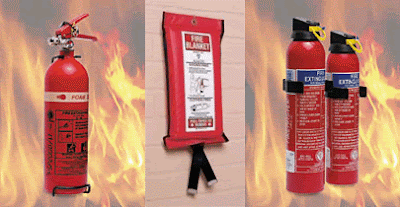
Fire Blankets
Miscellaneous Fire Products

FIRE SENSE UK ONLINE STORE

As well as providing safety information, Fire Sense is also a leading distributor of fire equipment.

Standard Members 10% discount on every purchase.
Fire Sense Plus Members 30% discount on every purchase

Wednesday, June 13, 2007

List of UK Public Fire and Rescue Services

England

Avon Fire and Rescue Service
Bedfordshire and Luton Fire and Rescue Service
Royal Berkshire Fire and Rescue Service
Buckinghamshire Fire and Rescue Service
Cambridgeshire Fire and Rescue Service
Cheshire Fire and Rescue Service
Cleveland Fire Brigade
Cornwall County Fire Brigade
County Durham and Darlington Fire and Rescue Service
Cumbria Fire & Rescue Service
Derbyshire Fire and Rescue Service
Devon and Somerset Fire and Rescue Service
Dorset Fire and Rescue Service
East Sussex Fire and Rescue Service
Essex County Fire and Rescue Service
Gloucestershire Fire and Rescue Service
Greater Manchester Fire and Rescue Service
Hampshire Fire and Rescue Service
Hereford and Worcester Fire and Rescue Service
Hertfordshire Fire and Rescue Service
Humberside Fire and Rescue Service
Isles of Scilly Fire and Rescue Service
Lancashire Fire and Rescue Service
Isle of Wight Fire & Rescue Service
Kent Fire and Rescue Service
Leicestershire Fire and Rescue Service
Lincolnshire Fire & Rescue Service
London Fire Brigade
Merseyside Fire and Rescue Service
Norfolk Fire & Rescue Service
Northamptonshire Fire and Rescue Service
Northumberland Fire and Rescue Service
North Yorkshire Fire and Rescue Service
Nottinghamshire Fire & Rescue Service
Oxfordshire Fire and Rescue Service
Shropshire Fire and Rescue Service
South Yorkshire Fire and Rescue Service
Staffordshire Fire & Rescue Service
Suffolk Fire & Rescue Service
Surrey Fire and Rescue Service
Tyne and Wear Fire and Rescue Service
Warwickshire Fire and Rescue Service
West Midlands Fire Service
West Sussex Fire and Rescue Service
West Yorkshire Fire and Rescue Service
Wiltshire Fire and Rescue Service

By Wikipedia

Sunday, June 10, 2007

Fire Extinguisher

A fire extinguisher is an active fire protection device used to extinguish or control small fires, often in emergency situations. Typically, a fire extinguisher consists of a hand held cylindrical pressure vessel containing an agent which can be discharged to extinguish a fire.

Usage
The typical steps for operating a fire extinguisher (described by the acronym "PASS") are the following:

P - Pull the safety pin
A - Aim the nozzle at the base of the fire, from a safe distance (about six feet away)
S - Squeeze the handle
S - Sweep the extinguisher from side to side while aiming at the base of the fire

There are various types of extinguishers, which are used for different types of fires; using the wrong type can worsen the fire hazard, but using the right one can better the situation. Please note: You are not required to fight a fire. Get out or away and call the Fire Department.

By Wikipedia

Wednesday, June 6, 2007

Regulatory Reform (Fire Safety) Order 2005

The Regulatory Reform (Fire Safety) Order 2005 is a statutory instrument which places the onus on individuals to carry out risk assessments on certain types of property and submit them to their local fire authority. Its full title is: Statutory Instrument 2005 No. 1541 The Regulatory Reform (Fire Safety) Order 2005. It became law on 1 October 2006, and only applies to England and Wales.

Office of Public Sector Information:
The Regulatory Reform (Fire Safety) Order 2005, England & Wales

Gas tank explodes during battle with flames

The Fire and Rescue Service were called to the Annesborough Industrial Estate on the Annesborough Road shortly before 8pm yesterday evening after receiving reports of a blaze in the former Irlandus Circuits premises.

The fire, in a large, unoccupied building which does not adjoin any other businesses, was well underway by the time firefighters arrived.

Group commander Alan Fulford said the operation was further complicated when a cylinder exploded. Two other cylinders inside the building were also in danger of exploding late last night.

"The building is quite large, fifty metres by fifty, so this is a major operation for us," he said.

He added that five fire appliances and an aerial platform were used by firefighters to tackle the incident, while two other fire trucks remained on stand-by.

A PSNI spokesman described the fire as a "major" incident.

He said the Fire Service were urging all householders in the vicinity of the estate to stay well away from the scene.

"They have also asked that residents keep all windows and doors closed," he added.

Written by Belfast Telegraph

Tuesday, June 5, 2007

Goals of Firefighting

The three main goals in firefighting are (in order) life safety, incident stabilization, property conservation and environmental preservation. Firefighting is an inherently difficult occupation. As such, the skills required for safe operations are regularly practiced during training evolutions throughout a firefighters career. In the United States, the preeminent fire training and standards organization is the National Fire Protection Association (NFPA). Often initial firefighting skills are taught during a local, regional, or state approved fire academy. Depending on the requirements of a department, additional skills and certifications such as technical rescue and Para-medicine may also be taught at this time.

Firefighters work closely with other emergency response agencies, most particularly local and state police departments. As every fire scene is technically a crime scene until deemed otherwise by a qualified investigator, there is often overlap between the responsibilities of responding firefighters and police officers such as evidence and scene protection, initial observations of first respondents, and chain of evidence issues. The increasing role of firefighters in providing emergency medical services also brings firefighters into common overlap with law enforcement. One example of this is a common state law requiring all gunshot wounds to be reported to law enforcement agencies.

Most career (full time, paid) firefighters in North America are represented by the International Association of Fire Fighters

Fire fighting has several basic skills: prevention, self preservation, rescue, preservation of property and fire control. Firefighting is further broken down into skills which include size-up, extinguishment, ventilation, and salvage and overhaul. Search and Rescue, which has already been mentioned, is performed early in any fire scenario and many times is in unison with extinguishment and ventilation.

By Wikipedia

Friday, June 1, 2007

Fire Equipments At Great Prices

Fire Equipments At Great Prices
Extinguisher Covers and Stands
Extinguishers Factory Sealed
Extinguishers Refillable
Fire Blankets
Miscellaneous Fire Products

FIRE SENSE UK ONLINE STORE

As well as providing safety information, Fire Sense is also a leading distributor of fire equipment.

Standard Members 10% discount on every purchase.
Fire Sense Plus Members 30% discount on every purchase

Sunday, May 27, 2007

Chief Fire Officer

The rank of Chief Fire Officer or CFO is the highest in the fire Service in England and Wales. Its equivalent in Scotland is Fire Master, although this title has been replaced by Chief Fire Officer in some Scottish brigades. With the changes to the UK fire service in 1974, the title changed to reflect the new county structures and now other titles for this office can include 'County Fire Officer' and 'Chief Executive', neither of which are in common use on their own for example, Greater Manchester FRS use the title 'County Fire Officer and Chief Executive'. In the London Fire Brigade, the CFO is known as 'Commissioner of the London Fire Brigade' - the post is currently held by Sir Ken Knight.

Responsibilities

A CFO is responsible for the day-to-day command of the fire service in all areas. Ultimately however major policies and procedures have to be agreed and passed by the Fire Authority to whom the CFO reports. The Fire Authority is a committee of locally elected councilors. The committee's prime responsibility is to ensure that the fire service is run properly and responsibly. In simple terms the Chief Officer is directly answerable to someone who represents the interests of the general public. The collective voice for CFOs on policy, planning and strategy in the UK is CFOA Chief Fire Officers Association, previously known as CACFOA (Chief and Assistant Chief Fire Officers Association).

By Wikipedia

Tuesday, May 22, 2007

London Fire Brigade

The London Fire Brigade (LFB) is the statutory fire and rescue service for London, England. It is run by the London Fire and Emergency Planning Authority and is the third-largest fire service in the world with nearly 7000 staff of which 5800 are operational firefighters and officers.

In 2004 it answered nearly 300,000 emergency calls, responded to 60,000 fires and over 5000 traffic accidents, making it one of the busiest fire brigades in the world. In 2005, it received over 9000 hoax calls, the highest number of all the fire brigades in the United Kingdom.

As well as fire fighting, the LFB responds to hazardous material incidents, conducts emergency planning and performs fire safety inspections and education.

It does not provide an ambulance service, this function is performed by the London Ambulance Service as an independent NHS Trust, however all firefighters are trained in first aid and fire engines - or appliances as they are known - carry first-aid equipment including basic resuscitators.

By Wikipedia

Monday, May 21, 2007

Fire Damages Famed Cutty Sark Ship (21st May 2007)

A spectacular fire caused heavy damage to the clipper ship Cutty Sark on Monday, adding millions to the cost of restoring one of London's proudest maritime relics. The cause of the blaze was under investigation, but within hours officials responsible for the graceful 19th-century sailing ship said they were determined to carry on with a four-year restoration project.

"We're going to redouble our efforts to ensure that the ship is open, available, back and running in the future," said Chris Livett, the chairman of Cutty Sark Enterprises, responsible for restoring the world's only surviving tea clipper.

Read Full Article at Fire Fighting News

Fire Classes

European and Australasian Classifications

In Europe and Australasia, a different classification system is used.

* Class A: Fires that involve flammable solids such as wood, cloth, rubber, paper, and some types of plastics.

* Class B:
Fires that involve flammable liquids or liquifiable solids such as petrol/gasoline, oil, paint, some waxes & plastics, but not cooking fats or oils.

* Class C:
Fires that involve flammable gases, such as natural gas, hydrogen, propane, butane.

* Class D:
Fires that involve combustible metals, such as sodium, magnesium, and potassium.

* Class E:
Fires that involve any of the materials found in Class A and B fires, but with the introduction of an electrical appliances, wiring, or other electrically energized objects in the vicinity of the fire, with a resultant electrical shock risk if a conductive agent is used to control the fire.

* Class F:
Fires involving cooking fats and oils. The high temperature of the oils when on fire far exceeds that of other flammable liquids making normal extinguishing agents ineffective.

The system is more or less the same as the U.S system, with letter designations shifted around - for instance, Class C fires in the U.S system are known as Class E in Europe.

By Wikipedia

Monday, May 14, 2007

Fire Fighting

Firefighting is the act of extinguishing destructive fires. A firefighter fights these fires and prevents destruction of life, property and the environment. Firefighting is a highly technical profession which requires years of training and education to become proficient in.

Historically, physicists created a graphical representation detailing the three elements of fire (fire triangle). In recent years, one more point has been added, creating the fire tetrahedron. The four elements needed to sustain combustion are:

fuel, oxidizer, heat and a chemical chain reaction.

To extinguish a fire, it is necessary to remove one or more of the four components of combustion. Removing any of these components of the fire tetrahedron will stop the other elements from interacting and not allow combustion to continue. Firefighters work on limiting exposures (fuel that is in jeopardy of being ignited by nearby flame or from radiant heat), containing and extinguishing fire and then overhauling charred and burned debris from the affected areas as well as extinguishing all hidden fires to prevent a rekindle.

Firefighters'
goals are to save life, property and the environment. A fire can rapidly spread and endanger many lives; however, with modern firefighting techniques, catastrophe is usually avoided. To prevent fires from starting a firefighter's duties include public education and conducting fire inspections. Because firefighters are often the first responders to people in critical conditions, firefighters provide basic life support as emergency medical technicians or advanced life support as licensed paramedics.

By Wikipedia

Saturday, May 5, 2007

Risks of a Fire

The primary risk to people in a fire is smoke inhalation (breathing in smoke); most of those killed in fires die from this, not from burns. The risks of smoke include:

* suffocation due to the fire consuming or displacing all the oxygen from the air;
* poisonous gases produced by the fire;
* aspirating heated smoke that can burn the inside of the lungs.

As an example, plastics inside a car can generate 200,000 m3 of smoke at a rate of 20-30 m3/sec. Firefighters carry self-contained breathing apparatus (SCBA) (an open-circuit positive pressure compressed air system) to prevent smoke inhalation.

Obvious risks stem from the effects of heat. Even without contact with the flames (conduction), there are a number of comparably serious risks: burns from radiated heat, contact with a hot object, hot gases (e.g., air), steam and hot and/or toxic smoke. Firefighters are equipped with personal protective equipment (PPE) that includes fire-resistant clothing (nomex or polybenzimidazole fiber (PBI)) and helmets that limit the transmission of heat towards the body.

The heat can make pressurised gas cylinders and tanks explode, producing what is called a BLEVE (Boiling Liquid Expanding Vapor Explosion). Some chemical products such as ammonium nitrate fertilizers can also explode. Explosions can cause physical trauma or potentially serious blast or shrapnel injuries.

Heat causes human flesh to burn as fuel causing severe medical problems. Depending upon the heat of the fire, burns can occur in a fraction of a second. A first degree burn (on the skin surface) is extremely painful. A second degree burn is a burn into the skin, and can cause shock, infections, and dehydration and if left untreated often results in death. Second degree burns compromise nerve tissue and are not painful. Third degree burns leave muscles and internal organs exposed from completely destroyed skin. If the person survives the shock and exposure to germs, medical treatment is extremely difficult.

By Wikipedia

Friday, May 4, 2007

Will The Fire Safety Order Affect Me?

Yes if you are:
• Responsible for business premises.
• An employer.
• Self employed with business premises.
• A charity or voluntary organisation.
• A contractor or agent with a degree of control over any premises.

Fire Risk Assessments
All non – domestic premises with 5 or more employees and all shared or common parts of a property with more than one occupier are legally required to produce a written fire risk assessment. Completing a fire risk assessment is not only a legal requirement under the FSO; it can also deliver realistic benefits to employers and their Company. Through the risk assessment, the likelihood of a fire and loss of life or injury can be significantly reduced. By taking a few simple steps, employers can not only prevent fires breaking out but also ensure their business continuity and safety of their premises and employees. This is an interesting viewpoint when you consider that:-

• 70% of businesses close within 2 years of the fire.
• 80% of businesses that suffer a moderate fire do not stay in business, lose their market share or lose their skilled staff to competitors.

By Pyrotech

Fire Watch

Fire watch, the act of watching for the occurrence of fires. This is usually done with the intent of detecting fires early so that they can be extinguished quickly and damage to land and/or property can be prevented or minimalized. Fire watches are often employed in forested areas where the risk of fires is high (dry conditions, hot weather, etc) or in industrial settings where "hot work" (welding, metal grinding, etc) is occurring.

By Wikipedia

Tuesday, May 1, 2007

Fire Hazard

A fire hazard is any situation in which there is a greater than normal risk of harm to people or property due to fire. Fire hazards can take the form of ways that fires can easily start, such as a blocked cooling vent, or overloaded electrical system, ways fires can spread rapidly, such as an insufficiently protected fuel store or areas with high oxygen concentrations, or things which, in a fire, pose a hazard to people, such as materials that produce toxic fumes when heated or blocked fire exits.

By Wikipeida: Fire Hazard

Saturday, March 10, 2007

New Fire Safety Rules

New fire safety rules, the Regulatory Reform (Fire Safety) Order 2005 will be enforced in England and Wales on October 1st 2006

Employers should start thinking about new fire safety responsibilities which come into force in October or face the risk of prosecution.

The Regulatory Reform (Fire Safety) Order 2005 means any employer responsible for "any premises in England and Wales where people gather" will have a duty to ensure the safety of everyone who uses their premises and those in the immediate vicinity who may be at risk if there is a fire.

The legislation covers nearly every type of building, structure and open space except for private homes and individual flats in a block or house, although communal areas will be affected.

Anyone responsible for premises must carry out a fire safety risk assessment by 1 October 2006. The Fire and Rescue Service will carry out inspections and failing to comply with the order may lead to a fine or up to two years imprisonment.

Fire Fighting News